여백 · 留白 · 間
Why Gaussian Splats Are Perfect for White Space in East Asian Art
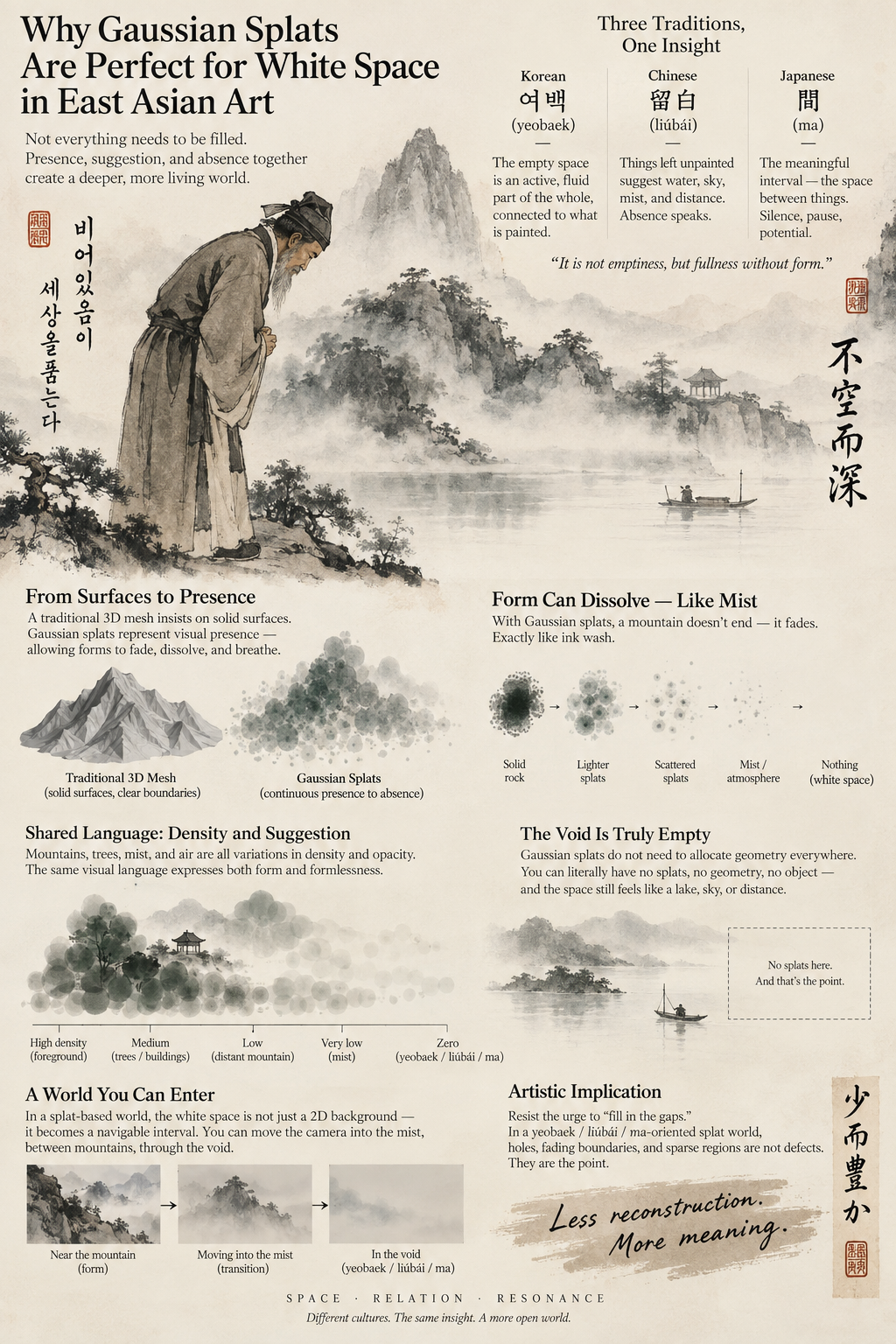
Not everything needs to be filled. Presence, suggestion, and absence together create a deeper, more living world.
여백 · 留白 · 間
Not everything needs to be filled. Presence, suggestion, and absence together create a deeper, more living world.
loading the brush…
비어있음이 세상을 품는다
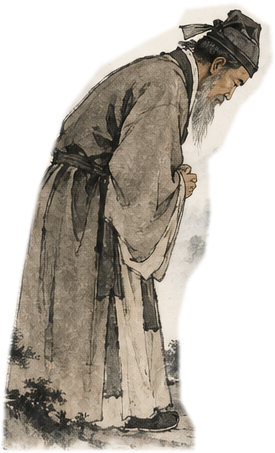
He bows to the part of the painting that was never painted. The paper he stands on, the lake, the sky: no splats were placed there, and the mist keeps moving.
A work to look at
In the splats
“It is not emptiness, but fullness without form.”
The mesh has to close every surface and pour a plane over the water. The splats never put anything there.
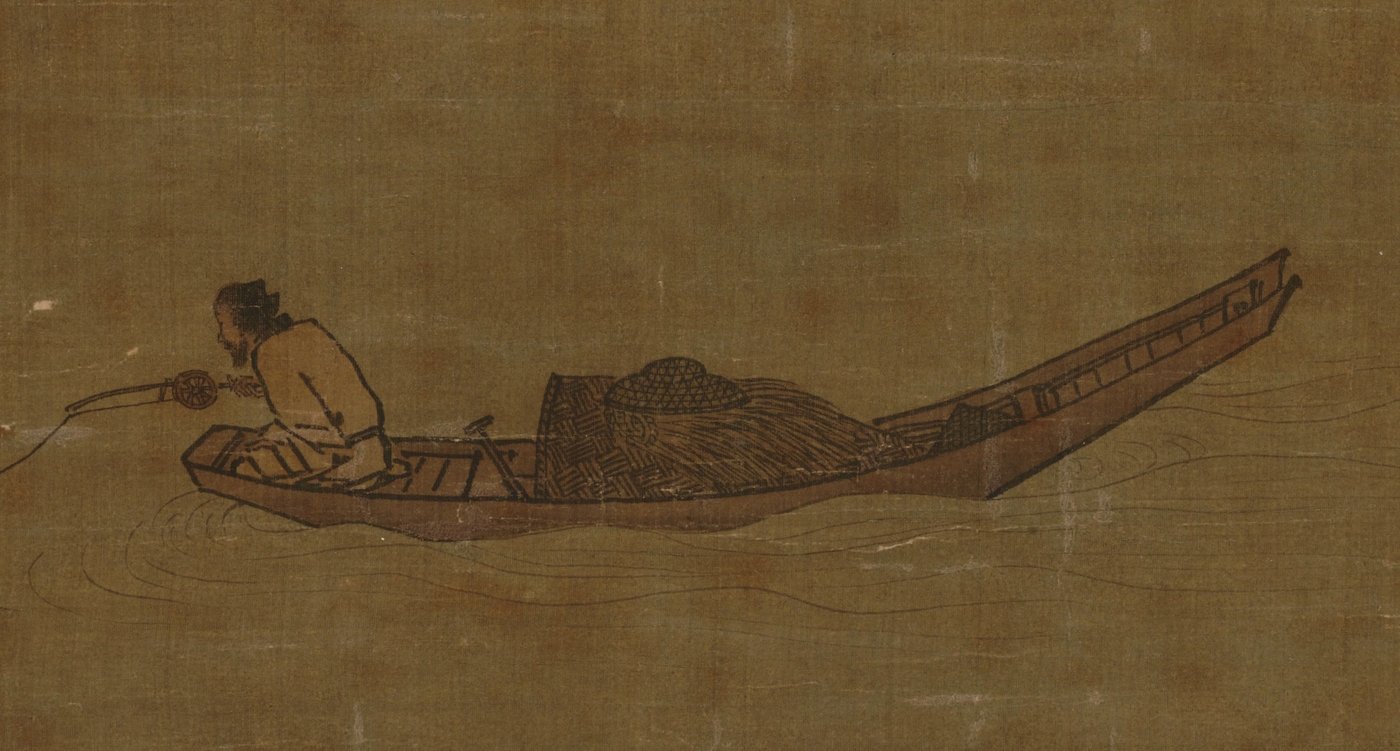
Ma Yuan, Angler on a Wintry Lake (detail), c. 1195 — the boat is all that was painted; everything else is silk left bare.
A lone boat rests on bare paper. No splats were ever placed here — not mist, not water, not even the palest wash. In Ma Yuan's one-corner compositions, in yeobaek, liúbái, and ma, this is not a gap waiting to be filled in later. The emptiness is the point.
research & theory
The Met — Landscape Painting in Chinese Art Ma Yuan and the "one-corner" (邊角) composition Notan — the design theory of light/dark negative space Daoist wú (無) — emptiness as generative, not absent 間 (ma) — the Japanese aesthetics of the intervalask about the void
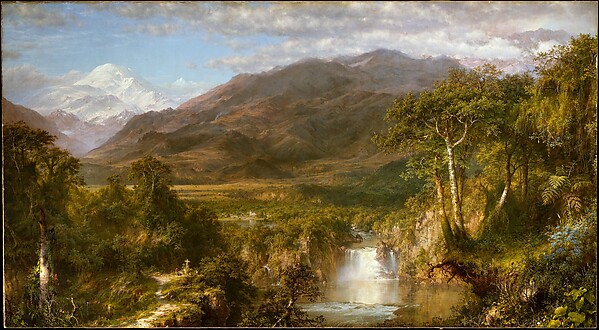
Frederic Edwin Church, Heart of the Andes, 1859. Oil on canvas, 168 × 302.9 cm. The Metropolitan Museum of Art, Bequest of Margaret E. Dows, 1909 (09.95).
Church crossed Ecuador twice with a sketchbook, under Humboldt's instruction to paint the whole of nature, then packed a continent into one canvas: tropical leaves painted specimen by specimen, a pool and its waterfall, a Spanish-colonial church out on the plain, a cross in the left foreground with figures stopped before it, a path worn through the brush, and Chimborazo's snow above all of it. In April 1859 it hung in a darkened room behind a chestnut frame thirteen feet tall, curtained to read as a window; twelve thousand people paid twenty-five cents and were handed opera glasses so they could hunt the foreground for one more leaf. Nothing is left unsaid. The reward is everything Church found for you.
Yeobaek (여백) pays the opposite reward: what you supply. The bare paper is lake, mist, sky, distance — and it is not quite the same twice. One tradition fills; the other withholds. Neither is missing anything.
Splats can work either way, which is exactly why the instinct matters. A splat scene has no surface to close, so a thin region is a result, not a hole to patch. Resist the urge to "fill in the gaps": holes, fading boundaries, and sparse regions are not defects. They are the point.