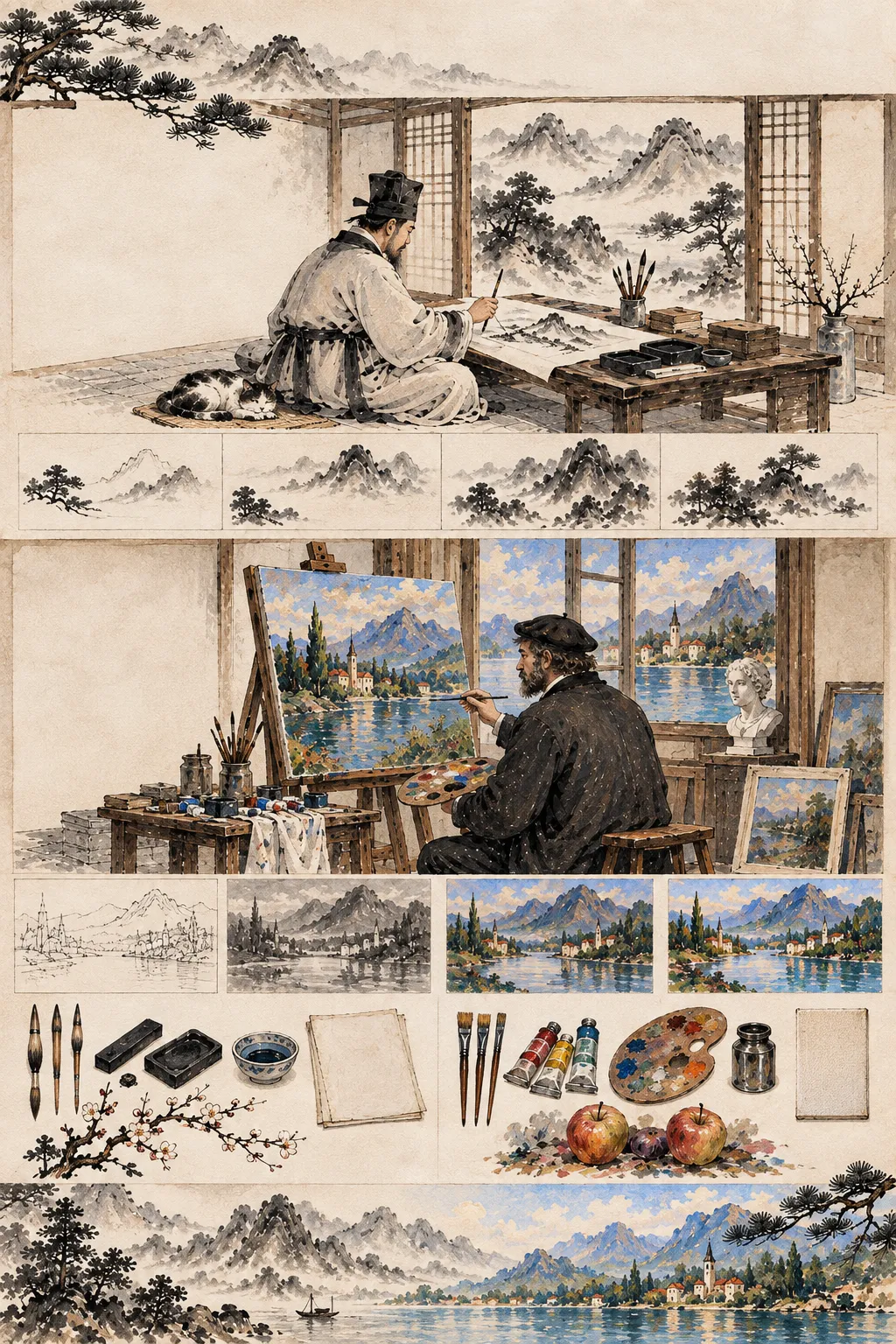
Painting what is left out: a stroke that cannot be taken back, one diluted black in place of colour, and the white space the viewer finishes.
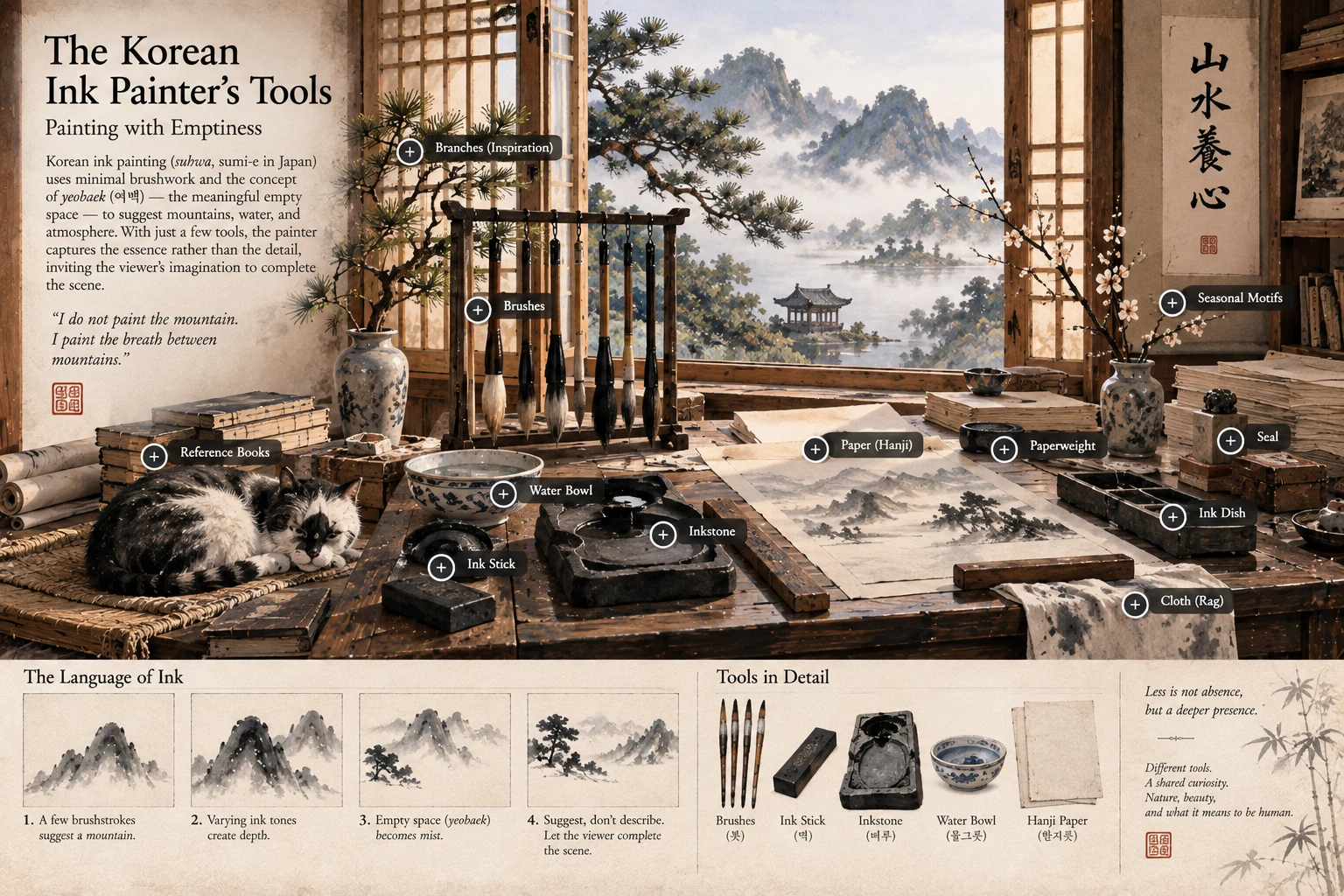
The Korean Ink Painter's Tools
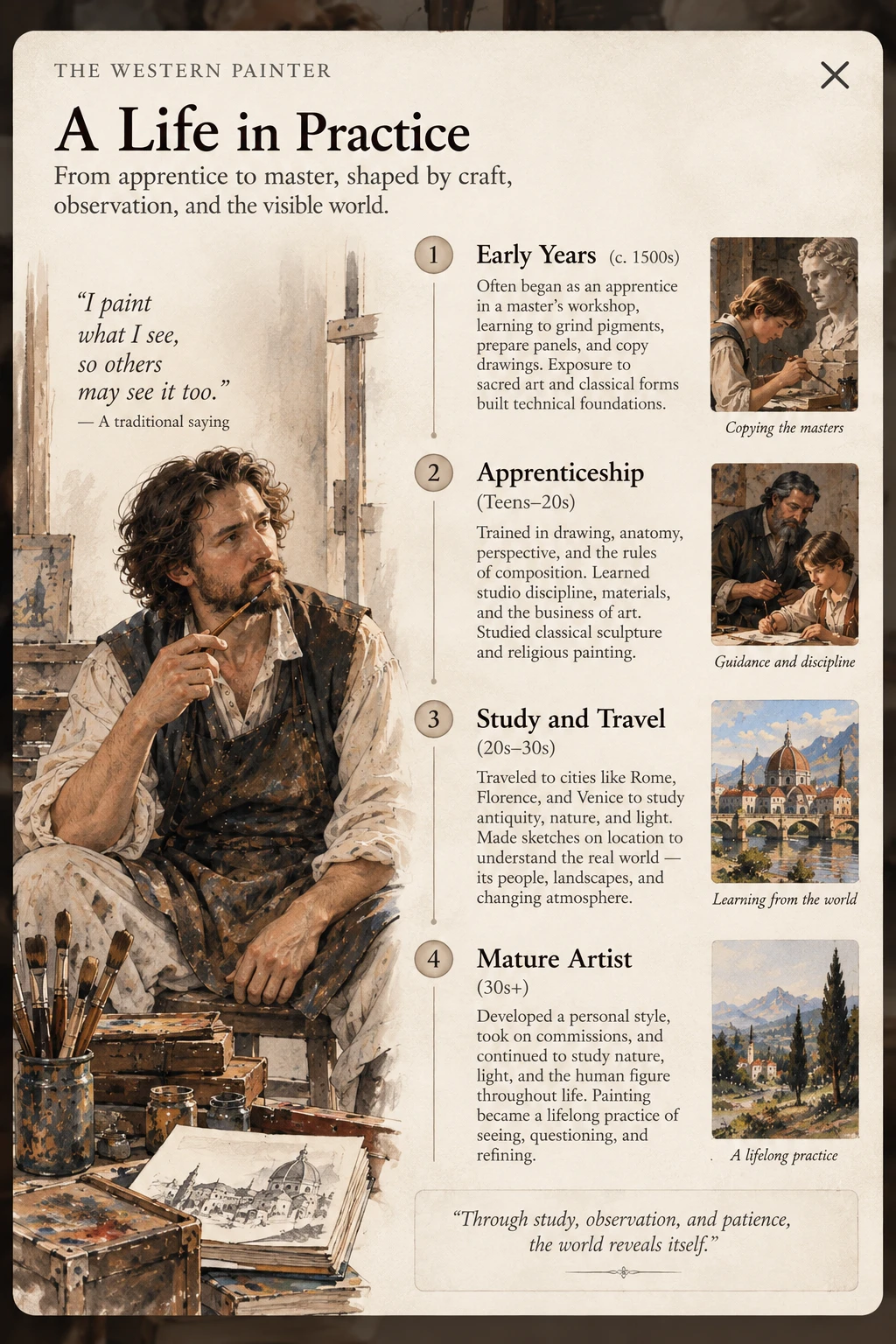
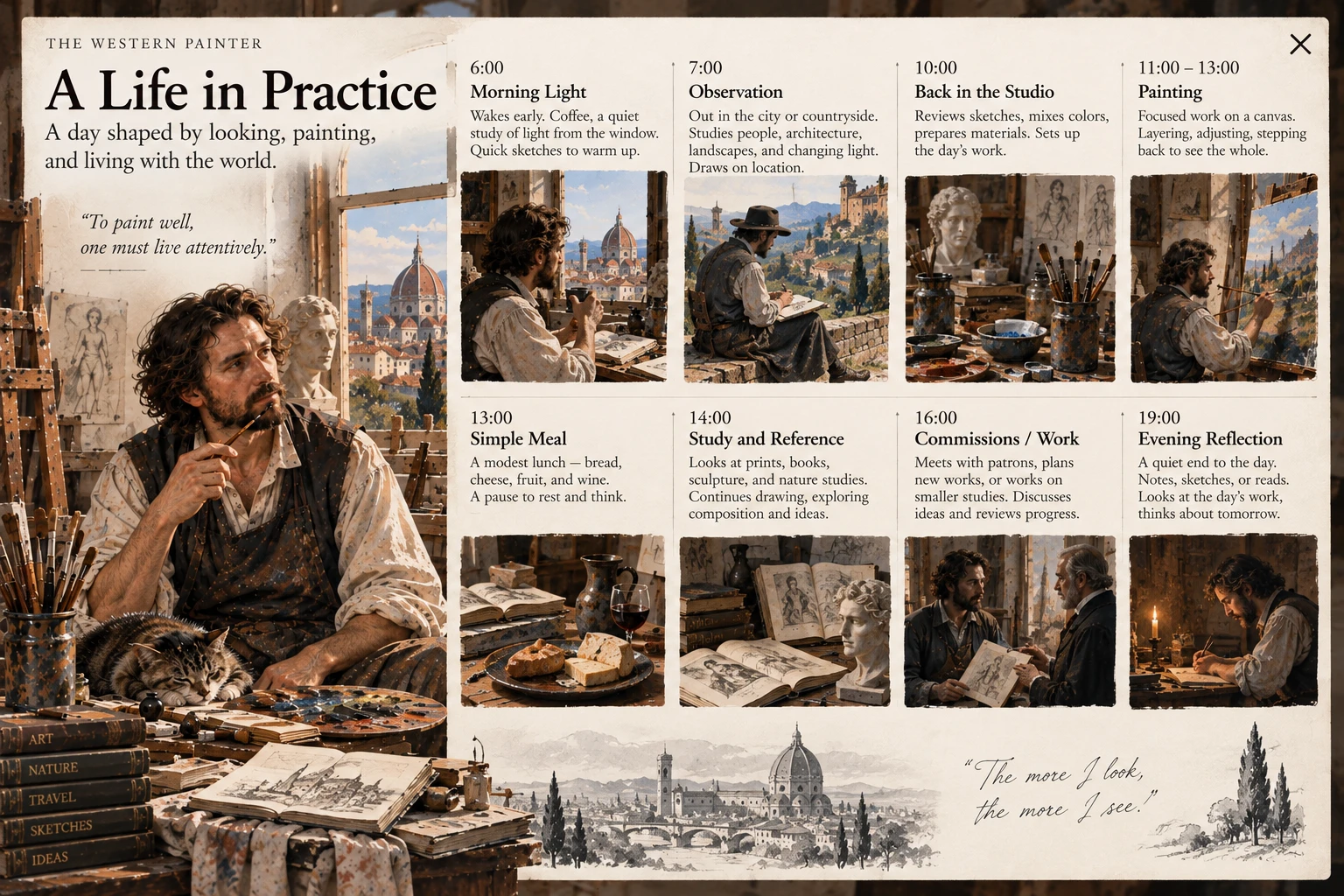
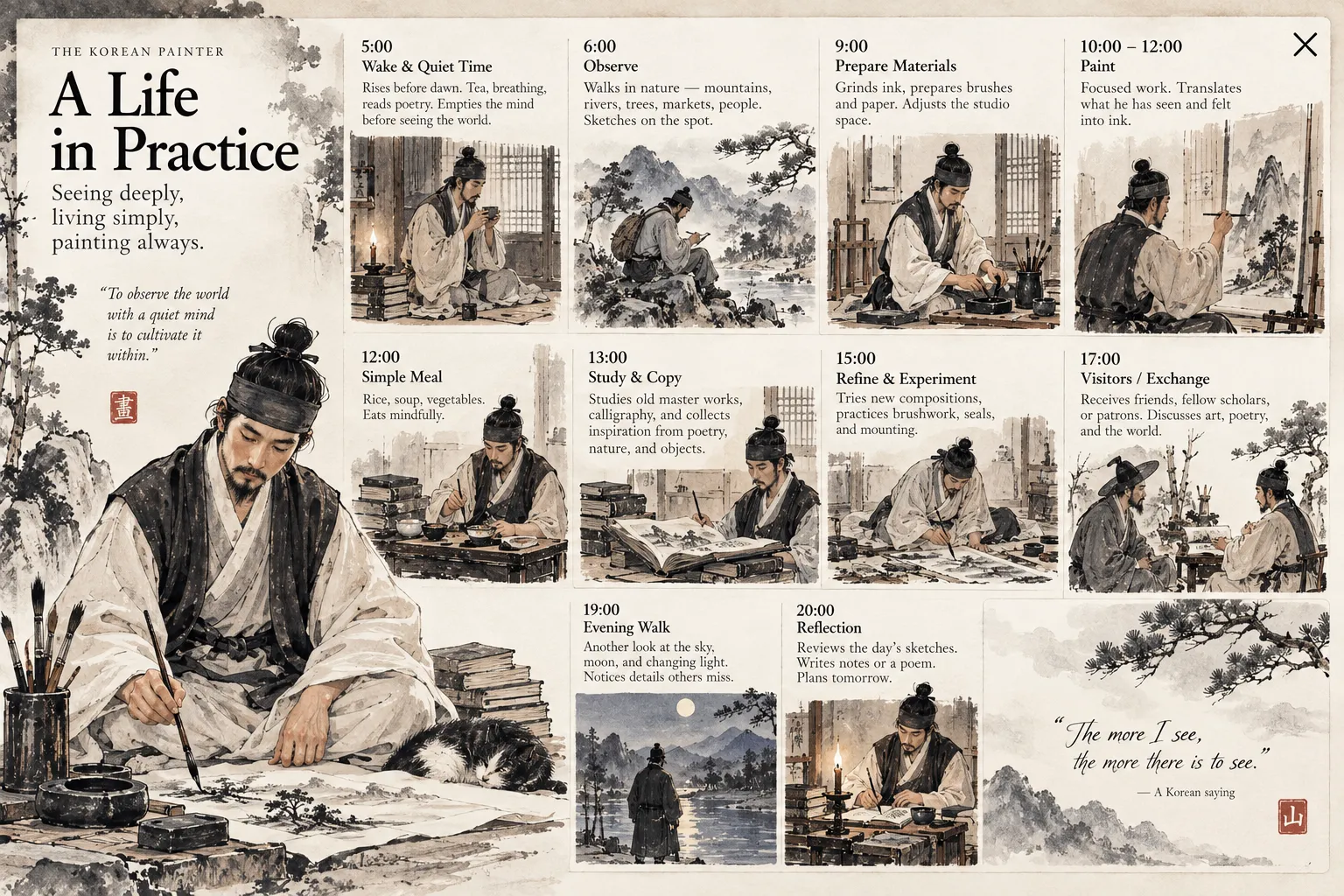
A pine branch and a plum bough, kept within reach — not decoration, but the actual subject the mountains on the paper are standing in for.
Goat, wolf, or weasel hair on a bamboo handle. One brush, loaded with more or less water, does what several Western brushes divide between them.
Plum blossom, pine, bamboo, chrysanthemum — the same handful of subjects returned to for centuries, valued for restraint rather than novelty.
Model books of ink technique, studied and copied before the painter departs from them — training that precedes observation, not replaces it.
Mulberry-fibre paper that drinks ink the instant it lands. Nothing can be lifted, scraped back, or painted over once the brush touches down.
Holds the sheet flat and still against the brush — hanji is thin enough to lift on a stray breath of air.
The painter's red stamp, pressed last: a mark of authorship, and the one true colour let into an otherwise monochrome work.
Where the brush is rinsed and reloaded. How much water survives the rinse decides whether the next stroke runs bone-dry or turns to mist.
Stone where the ink stick is ground with water into liquid ink — the grinding is part of the ritual, not a chore before the real work starts.
A shallow dish for ink already ground and ready, kept apart by tone so the painter can move between them without regrinding.
Solid pine soot and glue, ground fresh each sitting. One stick, and the entire tonal range comes from how much water meets it.
Wipes the brush, and blots a stroke that went too far — the one tool for correcting a medium that otherwise permits no correction.
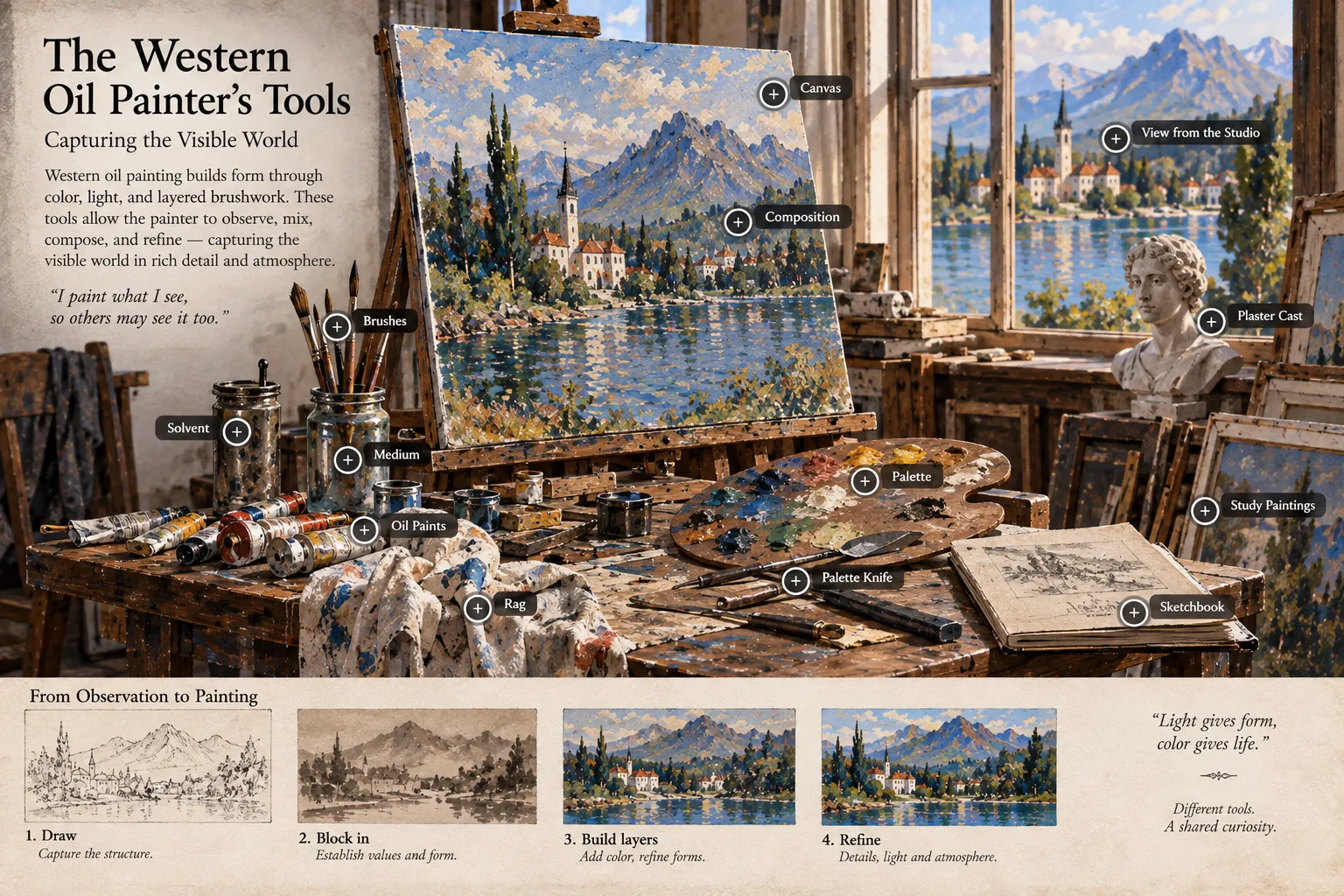
The Western Oil Painter's Tools
Primed linen or cotton, stretched taut — a surface that can be scraped back and reworked, unlike hanji.
The actual lake and village he is painting, seen through the window he is painting it from.
Where the eye enters and travels — decided before the first stroke, adjusted the whole time after.
Bristle and sable in a spread of widths, from blocking in shapes to laying a single highlight.
Drawn from until the eye is honest, then set aside — academic training standing in the corner of the room.
Turpentine or mineral spirits — thins paint, cleans brushes, and controls how fast each layer dries.
Linseed or stand oil mixed into paint to adjust flow and gloss, layer by layer, fat over lean.
Where colours are mixed before they touch the canvas — a working surface, not just a container.
Pigment ground in oil, in dozens of hues — the variable this tradition hands to the material, not the hand.
Smaller finished canvases, tried and set aside — evidence the same view was reconsidered more than once.
For scraping paint on in thick, textured strokes, or scraping it back off entirely.
Wipes brushes clean between colours, and lifts wet paint back off the canvas when a passage goes wrong.
Quick studies made on site, worked up into the finished painting back in the studio.
tap any band of the chart — six places where there is more to say.
One chance at every mark
Hanji is paper-mulberry fibre and it drinks. Ink arrives the moment the brush touches down: nothing can be lifted, scraped back, or painted over. So the decision happens before the stroke — in how much water is in the brush, how fast the hand travels, and above all in what will not be painted at all. Four things are on his table: 붓 brush, 먹 ink stick, 벼루 inkstone, 한지 paper — the four friends of the study (문방사우). Everything else is water.
The mountain he is painting is mostly not there. The white it stands in has a name — 여백 (yeobaek) — and it is not background. It is the part of the picture the viewer finishes.
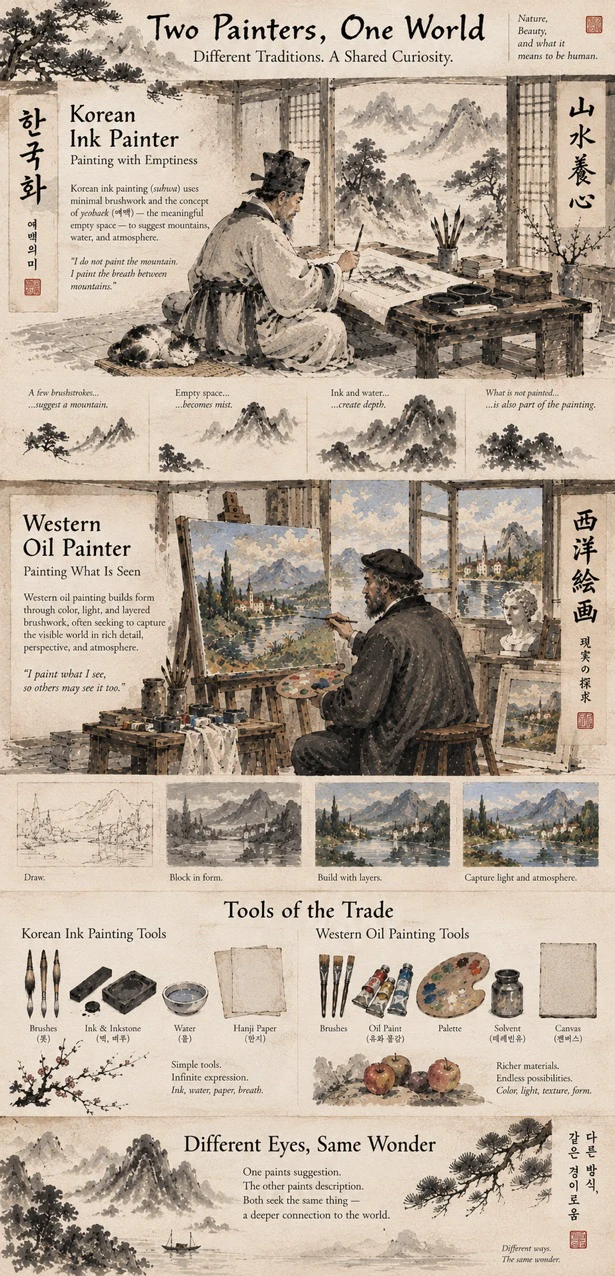
Read the strip as a single instruction. A few strokes suggest a mountain. Empty space becomes mist. Ink and water alone make depth — one black, diluted, standing in for every colour. And the last panel says the quiet part out loud: what is not painted is also part of the painting.
None of that is a workaround for a missing skill or a missing pigment. The restraint is the technique — which is why it survives being ported to another medium. A splat scene has no surface to close either, so a thin region there is a result, not a hole waiting to be patched.
Built up, layer over layer
Oil dries slowly, so a painting can be argued with for days. The conventional order is drawing, then a lean underpainting that settles the large shapes, then opaque body colour, then thin transparent glazes — fat over lean, more oil in each layer, so the surface stays flexible instead of cracking. Nothing is final until the last glaze.
Where the ink painter commits before the brush lands, this one commits last, and can change his mind about the whole lake on Thursday. He works at a window, from what is actually in front of him; the plaster bust beside him is the other half of that training — draw from the casts until the eye is honest, then go and look.
Draw. Block in form. Build with layers. Capture light and atmosphere. Every panel of the strip holds more than the one before it, and the last addition is the hardest thing to name: the haze between here and the far shore.
Both traditions end at atmosphere. One arrives by laying a thin veil of paint over everything. The other arrives by leaving the paper alone.
Count the tools
Four on the left, five on the right, and the difference is not thrift. Ink painting hands the variables to the hand: one black stick ground on a stone with water, and the entire tonal range comes out of how wet the brush is. Oil painting hands the variables to the material: pigment in oil in dozens of colours, a palette to mix on, solvent to thin and to clean.
The supports disagree too. Hanji takes the ink into the sheet. Primed canvas keeps the paint on top, where it can be scraped, glazed, and reworked next week. “Simple tools. Infinite expression.” “Richer materials. Endless possibilities.” Both captions are true, and neither is the generous one.
Different eyes, same wonder
One paints suggestion. The other paints description. Side by side they are not a scoreboard — the point is that each one is a choice, made on purpose, by someone who could have done otherwise.
A filled canvas rewards you with everything the painter found. A 수묵화 mountain rewards you with what you bring, and is not quite the same twice. That is the argument of the site this page belongs to: Gaussian splats can work either way, which is exactly what makes absence worth choosing.